Mercury is the closest planet to the sun in the solar system. Here are some scientific and interesting facts about this planet.
1.) Mercury was named for the fleet-footed messenger of the gods in Roman mythology – the equivalent of the Greek’s Hermes.
2.) Mercury is the first planet in distance from the Sun in the solar system. It is the smallest of the 8 planets.
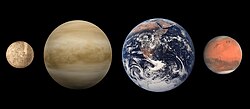
3.) This planet is the smallest of the rocky or terrestrial planets. The others are Venus, Earth, and Mars.
4.) Mercury is the only rocky planet other than Earth to have a global magnetic field, which is about 1% as strong as Earth’s.
5.) Like Venus, Mercury has no moons of its own.

6.) Although it is the nearest planet to the Sun, it is only the second hottest planet. Venus is the hottest.
7.) Mercury circles the Sun every 88 Earth days at an average distance of 58 million km and takes 59 days to turns on its axis.
8.) Mercury’s diameter is 4,879 km, about 40% the diameter of Earth or about 40% wider than the Moon.
9.) Mercury’s volume and mass are about one-eighteenth that of Earth.
10.) Mercury’s mean density, 5.4 g/cm³, is nearly as great as that of Earth and is higher than that of any of the other planets.
11.) The force of gravity on the planet’s surface is about 1/3 of that on Earth’s surface or about twice the surface gravity on the Moon and about the same as the surface gravity on Mars.
12.) Jupiter’s moon Ganymede and Saturn’s moon Titan are larger than Mercury but are much less dense.
13.) Mercury orbits the Sun every 87.97 Earth days at an average distance of approximately 58 million km.
14.) Mercury’s orbit is highly elliptical and ranges from 46 million km at its nearest point to the Sun (perihelion) to 69.8 million km at its farthest point (aphelion).
15.) As a result, sunlight is over 2.3 times stronger at perihelion than at aphelion.
16.) At a single orbit, Mercury receives as much as 11 times the intensity of sunlight that Earth does to a minimum of about 4.5 times.
17.) Mercury’s orbital velocity is also about 46 percent faster at perihelion than at aphelion. The planet’s orbit is tilted 7 degrees to the plane in which Earth orbits around the Sun.
18.) When viewed from North Pole. Mercury turns counterclockwise (west to east) like Earth and most other planets.
19.) Earth’s axis is tilted 23.5° while Mercury’s axis is almost perfectly vertical. Because its axis is vertical, like Venus, Mercury does not have seasons.
20.) Mercury rotates only once every 58.65 days, 2/3 of its period of revolution around the Sun.
21.) A complete solar day on Mercury lasts 175.84 Earth days, or two of Mercury’s years, and a night and a day at the equator each last one Mercurian year or 87.97 Earth days.
22.) Mercury preserves a record of a violent early period when asteroids, comets, and other debris bombarded the newly formed planets.
23.) The craters on Mercury are shallower than those on the Moon.
24.) The largest geological feature on Mercury is the Caloris Basin. It is the result of a massive ancient impact.
25.) Mercury’s surface is crisscrossed by long escarpments or cliffs.
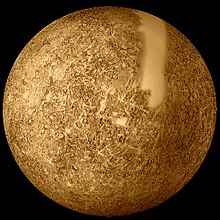
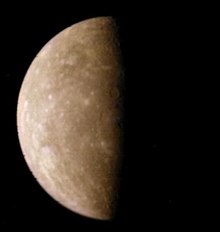
26.) Mercury is a poor reflector of sunlight because its surface consists of dark, dry soil called regolith created by micrometeorite impacts over billions of years.
27.) The planet’s albedo, or the amount of sunlight it reflects, is only about 12 percent, about the same as our Moon.
28.) Surface temperatures on Mercury can be as hot as 650°C.
29.) Mercury’s side facing the Sun gets very hot—up to 450°C—while the side facing away quickly cools to frigid temperatures, -183°.
30.) The floors of craters at the north and south poles receive very little sunlight and always remain extremely cold—about -200°C.
31.) Mercury’s equatorial region experiences extreme changes, reaching 450°C at perihelion when facing the Sun—hot enough to melt zinc.
32.) In 1991 powerful radio telescopes on Earth revealed signs of possible deposits of ice in the polar regions of Mercury.
33.) These ice deposits occur in areas where sunlight never falls, such as crater bottoms near both of the planet’s poles.
34.) The ice on Mercury likely comes from comets or water-bearing meteorites that have hit Mercury over the planet’s history up through the present.
35.) Scientists use a technique called spectroscopy to conduct studies of the light that Mercury reflects.
36.) These studies indicate that planet has only an extremely thin atmosphere, containing sodium and potassium.
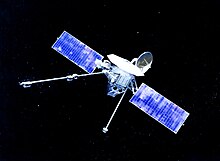
37.) The first up-close study of Mercury came with National Aeronautics and Space Administration (NASA)’s Mariner 10 spacecraft, which passed Mercury twice in 1974 and once in 1975.
38.) It sent back pictures of a moonlike, crater-pocked surface. The spacecraft also detected a magnetic field and provided data about the planet’s density and some of its surface chemistry.
39.) In 2004, NASA launched a much more ambitious mission to Mercury – the so-called MESSENGER- MErcury Surface, Space ENvironment, GEochemistry, and Ranging.
40.) MESSENGER is set to enter orbit around Mercury in 2011. The first orbital image of Mercury was obtained on March 29, 2011.
See also
- 35+Amazing and Interesting Scientific Facts About the Planet Venus
- Amazing and Interesting Facts About the Planet Jupiter
- Amazing Things About Our Solar System
- 50 Amazing and Interesting Facts About the Moon
- Top Ten Largest Stars in the Universe
- 15 Quick and Amazing Facts About the Earth and the Universe