Thursday, November 3, 2011

Interesting Scientific Facts About the Planet Saturn

One of the largest planets in our Solar System is Saturn. Here’s a list of amazingly important and interesting facts about this planet.

1.) This planet is named after Saturn, the Roman god of agriculture, the equivalent of the Greek’s Cronus.

2.) Saturn is the 2nd largest planet in the Solar System after Jupiter.

3.) It is the 6th planet in order of distance from the Sun.

4.) The planet’s most distinctive feature is a giant system of rings that surrounds the planet at its equator, stretching over twice the width of the planet itself.

5.) 1n 1610, the first person to see the rings was the Italian scientist Galileo with the used of his telescope.


6.)  Saturn when viewed from Earth appears as a yellowish object and is one of the brightest in the night sky.

7.) Saturn takes about 29.5 years to orbit the Sun at an average distance of 1,435 billion km.

8.) Saturn rotates on its axis in about 10.5 hours and is tilted at about 27°, giving the planet distinct seasons.

9.) The diameter of Saturn is about 121,000 km (75,000 mi), and its mass is equal to the mass of about 95 Earths, making it the second largest planet in our solar system after Jupiter.

10.) Saturn is 10 percent wider at its equator than at its poles and has a more oblate (flattened sphere) shape than any other planet.

11.) The National Aeronautics and Space Administration (NASA) launched the orbiter Cassini spacecraft toward Saturn in October 1997 and reached Saturn in July 2004.

12.) Cassini had detected carbon molecules and geysers on Saturn’s moon Enceladus

13.) Saturn is the least dense of the solar system’s planets. The mean density of Saturn is eight times less than that of Earth because the planet consists mainly of the lightweight gas hydrogen.

14.) Saturn to radiate into space three times as much heat as it receives from the Sun.

15.) Saturn receives about 1.1 percent as much sunlight as Earth does.
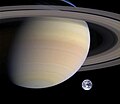

As compared to the Earth

16.) Saturn's atmospheric constituents are, in order by mass, hydrogen (88 percent) and helium (11 percent); and traces of methane, ammonia, ammonia crystals, and such other gases as ethane, acetylene, and phosphine comprise the remainder.

17.) The temperatures of Saturn's cloud tops are close to –176°C, about 27 degrees Celsius lower than such locations on Jupiter.

18.) Saturn’s rings are named in order of their discovery, and from the planet outward they are known as the D, C, B, A, F, G, and E rings.

19.) The Cassini probe discovered an additional faint ring between the G ring and the F ring in 2006.

20.) The main rings are now known to comprise more than 100,000 individual ringlets, each of which circles the planet.

21.) The visible rings stretch out to a distance of 136,200 km from Saturn's center, but in many regions they may be only 5 m (16.4 ft) thick.

22.) They are thought to consist of aggregates of rock, frozen gases, and water ice ranging in size from less than 0.0005 cm in diameter to about 10 m in diameter—from dust to boulder size.

23.) The apparent separation between the A and B rings is called Cassini's division, after its discoverer, the French astronomer Giovanni Cassini.

24.) Saturn has at least 62 moons that range up to 2,575 km in radius and consist mostly of the lighter, icy substances. Only 53 have formal names. There are also hundreds of moonlets on the planet’s rings.

25.) Twelve moons of Saturn were discovered in 2005, 9 moons were discovered in 2006 and 4 moons were discovered in 2007.
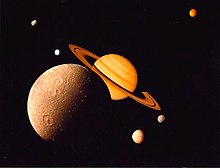


26.) The five larger inner satellites of Saturn are Mimas, Enceladus, Tethys, Dione, and Rhea. These moons are roughly spherical in shape and composed mostly of water ice and are heavily cratered by meteorite impacts.

27.) The outer satellites of Saturn are Hyperion and Iapetus. These satellites also consist mainly of water ice.

28.) Phoebe, the farthest large satellite, moves in a retrograde orbit (in the opposite direction of the orbits of most of the other satellites) that is at a sharp angle to Saturn's equator.

29.) Saturn’s largest moon is the Titan. It orbits the planet between the inner and outer satellites and has a radius of 2,575 km.

30.) Titan is larger than the planet Mercury and features large rock-like objects probably made of ice.

See also
Enhanced by Zemanta

Saturday, October 22, 2011

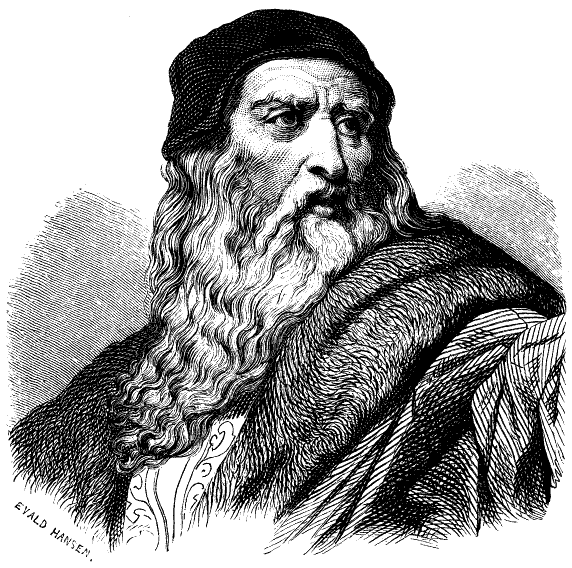
Interesting Facts About Leonardo Da Vinci: Creator of Mona Lisa and The Last Supper

Leonardo Da Vinci is one of the most famous men in history. He is well remembered for his Mona Lisa and The Last Supper – considered as the world’s greatest painting.

1.) Leonardo di ser Piero da Vinci was born on April 15, 1452 in Florence, Italy. He was never married and had no children.

2.) Da Vinci was left-handed. He is regarded as the most universally recognized left-handed artist of all time. Amazingly, he wrote in mirror image because of his left handedness.

3.) He was a person of exceptional talent and skills. He was a polymath, sculptor, painter, musician, architect, mathematician, scientist, inventor, engineer, geologist, anatomist, writer, cartographer and botanist.

4.) He is regarded as a “Renaissance Man”, a man of "unquenchable curiosity" and "feverishly inventive imagination".

5.) He is widely considered to be one of the greatest painters of all time and perhaps the most diversely talented person ever to have lived.


6.) Leonardo appears to have had no close relationships with women except for his friendship with the two Este sisters, Beatrice and Isabella.

7.) Beyond friendship, Leonardo kept his private life secret.

8.) Da Vinci’s sexuality has been the subject of satire, analysis, and speculation.

9.) Leonardo's most intimate relationships were perhaps with his pupils Salai and Melzi.

10.) Melzi, writing to inform Leonardo's brothers of his death, described Leonardo's feelings for his pupils as both loving and passionate.

11.) Gian Giacomo Caprotti da Oreno, nicknamed Salai or Il Salaino ("The Little Unclean One" i.e., the devil), entered Leonardo's household in 1490.

12.) After only a year, Leonardo made a list of his misdemeanors, calling him "a thief, a liar, stubborn, and a glutton", after he had made off with money and valuables on at least five occasions, and spent a fortune on clothes.

13.) Nevertheless, Leonardo treated him with great indulgence and he remained in Leonardo's household for the next thirty years.

14.) Salai executed a number of paintings under the name of Andrea Salai, but although Vasari claims that Leonardo "taught him a great deal about painting".

15.) In 1515, Salai painted a nude version of the Mona Lisa, known as Monna Vanna.


16.) Salai owned the Mona Lisa at the time of his death in 1525, and in his will it was assessed at 505 lire the equivalent of £200,000, an exceptionally high valuation for a small panel portrait.

17.) In 1506, Leonardo took on another pupil, Count Francesco Melzi, the son of a Lombard aristocrat, who is considered to have been his favorite student.

18.) Melzi traveled to France with Leonardo, and remained with him until the latter's death.

19.) Upon Leonardo's death, Melzi inherited the artistic and scientific works, manuscripts, and collections of Leonardo, and faithfully administered the estate. His brothers received piece of lands. Salai received half of Leonardo’s vineyards.

20.) Based on Florentine court records of 1476, Leonardo and three other young men were charged with sodomy with a male prostitute but were acquitted.

21.) Leonardo da Vinci was born out of wedlock to a Piero da Vinci, a legal notary and Caterina, a peasant woman.

22.) Da Vinci’s “Mona Lisa” is the most famous and most parodied portrait in the world.

23.) His “The Last Supper” is the most reproduced religious painting of all time.

24.) At the age of twenty, Leonardo qualified as a master in the Guild of St. Luke, the guild of artists and doctors of medicine.

25.) He died on May 2, 1519 at the age of 67. Da Vinci was buried in the Chapel of Saint-Hubert in Château d'Amboise.


26.) Da Vinci’s Codex Leicester was bought in an auction for $30.8 million by Bill Gates in 1994. Presently, Codex Leicester is the most expensive book ever sold.

27.) Codex Arundel and Codex Atlanticus are other well known compilations of Da Vinci.

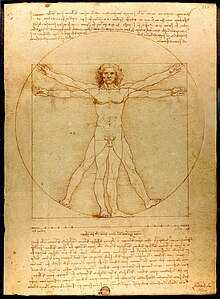
28.) Vitruvian Man is Leonardo Da Vinci’s most famous drawing. It is a study of the proportions of the human body, linking art and science.

29.) Leonardo Da Vinci was a vegetarian and wore brightly-colored clothes.

30.) He is tall, athletic and extremely handsome man.

31.) Leonardo drew the plans for the first armored car and also designed the cannon, a machine gun, gliders, turnspit for roasting meat and canal system to irrigate fields.

32.) Da Vinci was as much an inventor as an artist. Many of the inventions he designed are in use today such as the helicopters and parachutes.

33.) Leonardo Da Vinci was dyslexic.

34.) Leonardo was 23 when Michelangelo was born and 31 when Raphael was born.

35.) Raphael only lived until the age of 37 and died in 1520, the year after Leonardo, but Michelangelo went on creating for another 45 years.
Vitruvian Man

See also

Friday, October 21, 2011

50 Interesting and Amazing Facts About the Sun


The sun is the most important object in our solar system. Here are some fascinating and interesting facts about this heavenly object.

1.) The Sun is the closest star to Earth. It is located at the center of the Solar System.

2.) This huge mass of hot, glowing gas has strong gravitational pull that holds Earth and the other planets in the solar system in orbit.

3.) The light of the Sun and its heat influence all of the objects in the solar system and allow life to exist on Earth. Without the sun, there is no life.

4.) The Sun is an average star. It is one of the hundreds of billions of stars in the Milky Way with medium range in size, age, and temperature.

5.) Milky Way, which contains about 400 billions of stars, is just one of more than 100 billion galaxies in the observable universe.  


6.) The beautiful and useful Sun is 4.6 billion years of age and will continuously shine for the next 7 billion years.

7.) Beautiful as it is, the sun is also harmful to humans. It can cause skin cancer and can damage the eyes when directly look at even with sunglasses or during an eclipse.

8.) The Sun is large and massive object with a radius of 695,508 km which is 109 times as large as Earth’s radius.

9.) A million Earths could fit inside the Sun if it is a hollow.

10.) The Sun has a mass of 1.989 x 1027 metric tons or 1,989,000,000,000,000,000,000,000,000. That is 1,989 followed by 24 zeroes.

11.) The Sun’s average density is only 1.409 g/cu cm, which is a quarter of the average density of Earth.

12.) The Sun is 333,000 times as large as our Earth.

13.) The Sun generates 3.83 x 1026 watts of power in the form of light. In comparison, an incandescent lamp emits 60 to 100 watts of power.

14.) The temperature of the outer, visible part of the Sun is 5500°C.

15.) The average distance of the Sun from the Earth is 150 million km. The distance is so great that the Sun appears small when viewed from the planet.


16.) Due to the huge distance, it takes 8 minutes for the light from the Sun to reach Earth.

17.) Proxima Centauri is the Sun’s nearest stellar neighbor. It is 4.3 light-years from our solar system, meaning light from Proxima Centauri takes 4.3 years to reach the Sun.

18.) This great distance between the Sun and Proxima Centauri is equivalent to 30 trillion kilometers which is impossible for humans to reach.

19.) The Sun is so much closer to Earth than all other stars are that the intense light of the Sun keeps us from seeing any other stars during the day.

20.) The Sun is a second-generation star, meaning that some of its material came from former stars.

21.) Some stars in our galaxy are nearly as old as the expanding universe which is about 14 billion years old.

22.) The main ingredient of the Sun is hydrogen. It also contains heavier elements, such as carbon, nitrogen, and oxygen.

23.) The Sun is located in the outer part of the Milky Way galaxy, at a distance of 2.6 x 10¹⁷ km from the center.

24.) The Sun moves with great speed around the center at a velocity of 220 km/s, takes 250 million years to complete one trip around the center of the Milky Way galaxy.

25.) The Sun has circled the Milky Way galaxy more than 18 times during its 4.6-billion-year lifetime.


26.) The largest accurately determined stellar mass is of a star called V382 Cygni. This gigantic star is 27 times that of the Sun.

27.) The apparent magnitude of the Sun is -26.72. The apparent magnitude of the brightest star in Earth’s night sky, Sirius, is -1.46. Stars with negative magnitudes are the brightest of all.
28.) The Sun’s absolute luminosity is 3.86 x 1026 watts.

29.) After 3 billion years from now, the Sun will be hot enough to boil Earth’s oceans away.
30.) Four billion years thereafter, the Sun will have used up all its hydrogen and will balloon into a giant star that engulfs the planet Mercury.
31.) After 7 billion years from now, the Sun will be a red giant star. It will then be 2,000 times brighter than it is now, and hot enough to melt Earth’s rocks.
32.)  At this time the outer solar system will get warmer and more habitable. The icy moons of the giant planets may warm enough to be covered by water instead of ice.
33.) About 8 billion years from now, the Sun will become a white dwarf star and after it becomes a white dwarf, it will cool slowly for billions of years, eventually becoming so cool that it will no longer emit light.

34.) In just one second the Sun emits more energy than humans have used in the last 10,000 years.

35.) The visible part of the Sun is called the photosphere.


36.) The Earth and the Sun both rotates from west to east when viewed from above the North Pole, but unlike Earth, different parts of the Sun rotate at different rates

37.) A spot at the Sun’s equator takes 25 days to rotate completely, while a spot 15° from the poles takes 34 days to make a complete rotation.

38.) Sunlight appears yellowish, but it is actually a combination of a rainbow of colors.

39.) Red has the longest wavelength of visible light, and violet has the shortest.

40.) The corona is the very hot layer of the solar atmosphere above the chromospheres

41.) The chromosphere and photosphere are closer to the Sun’s core than is the corona, but the corona is several hundred times hotter than the chromosphere and photosphere.

42.) The chromosphere is a thin layer about 2,000 to 3,000 km (about 1,200 to 1,900 mi) thick, just above the visible photosphere.

43.) The biggest sunspots exceed Earth in size and are easily visible with a telescope. Sunspots rotate with the Sun and change in size and shape. They come and go, with lifetimes lasting from hours to months.

44.) The Greek philosopher Aristotle was the first known person to use a device that allowed indirect observation of the Sun.

45.) Galileo was the first person to use telescope in conducting observation of the Sun.


46.) During a total solar eclipse, the solar corona can be seen with the naked eye, during the brief period of totality.

47.) A solar eclipse as viewed on Earth occurs when the Moon passes between the Sun and the Earth.

48.) There are two types of solar eclipse – partial and total. The next partial eclipse will occur on November 25, 2011 and the last partial eclipse was on July 1, 2011.

49. The last full solar eclipse occurred on July 11, 2010 and the next total eclipse will be on November 13, 2012.

50.)  Solar eclipses can occur up to 5 times per year and since 1582, the years 1693, 1758, 1805, 1823, 1870, and 1935 have had five solar eclipses. The next occurrence will be 2206.

See also

Tuesday, October 18, 2011

Modern Passenger Ship and Ferry Stations in the Most Beautiful Sites of the World

I'd rather choose a ship instead of an airplane. Have you experienced being on board a ferry or a ship? I am sure it’s really a unique and fun experience. Here’s a list of attractive terminals for ships and ferries…

1.) Ariake Passenger Ship Terminal


The Ariake Passenger Ship Terminal is located in Koto, Tokyo. Notable structures near it are the Tokyo Big Sight, Conference Tower and West Exhibition Hall.Ariake. Tokyo.

2.) Fergeavgang I Utne


Fergeavgang I Utne is a beautiful ferry terminal located in Norway.

3.) Gudvangen Ferry Terminal


Gudvangen Ferry Terminal is another ferry terminal located in the beautiful country of Norway.

4.) Prince George Wharf


Prince George Warf is a facility serving passenger cruise ships in Nassau Harbor, off the island of New Providence in the Bahamas.
5.) Kai Tak Cruise Terminal


Kai Tak Cruise Terminal is located at the Tip of The Ex-Kai Tak Airport Runway in Hong Kong.

6.) Lonsdale Quay


Lonsdale Quay is located in Vancouver, Canada. Downtown Vancouver and Stanley Park is in the background.

7.) Star Cruises Terminal


This attractive passenger ship terminal is the Star Cruises Terminal.

8.) Douglas Sea Terminal


This passenger ship terminal is the facade of the Douglas Sea Terminal in the Isle of Man. It is actively used by the Isle of Man Steam Packet Company to ferry passengers, cars, and freight to points within the British Isles.

9.) San Francisco Ferry Terminal


The Ferry Building is a terminal for ferries located on the San Francisco Bay. The Bay Bridge is in the background.

10.) Vallejo Ferry Terminal


The Vallejo Ferry Terminal is a beautiful ferry terminal located in Vallejo, California. This transportation facility is the northernmost terminal in the San Francisco Bay Area.

See also
Enhanced by Zemanta

Monday, October 17, 2011

Unique and Intriguing Modern and Ancient Structures in the World


These iconic landmarks are popular tourist destinations in the world. These structures are either unique or intriguing. Keep that mouse scrolling…

Rock Garden – India


The Rock Garden is well known for its sculptures made from recycled ceramic. This sculpture garden is located in Chandigarh, India hence it is also called Rock Garden of Chandigarh. Also known as Nek Chand's Rock Garden after its founder Nek Chand, the garden spread over an area of 160,000 m². All the structures are completely built of industrial & home waste and thrown-away items.

Terra Cotta Army – China


The Terracotta Army or the "Terra Cotta Warriors and Horses", is a collection of terracotta sculptures depicting the armies of Shi Huangdi, the First Emperor of China and the builder of the Great Wall of China. Theses thousands of figures are more than 2,000 years old and were discovered in 1974.

These statues are located near the Mausoleum of the First Qin Emperor. The figures vary in height 1.83–1.95 meters and were arranged according to their roles, with the tallest being the generals. It is estimated that are 8,000 soldiers, 130 chariots with 520 horses and 150 cavalry horses in the site.

Moai – Easter Island, Chile


There are 887 Moai statues in the Easter Island. These intriguing figures were created by early Rapanui people that inhabited the island. The island is part of Chile and is located in the southeastern Pacific Ocean. The place is declared a UNESCO World Heritage Site.

Stonehenge – United Kingdom


Stonehenge is a prehistoric monument located in the English county of Wiltshire, about 3.2 km west of Amesbury and 13 km north of Salisbury. One of the most famous sites in the world, Stonehenge is composed of earthworks surrounding a circular setting of large standing stones.


This iconic stone monument is believed to have been erected around 4500 years ago. It is situated at the center of the densest complex of Neolithic and Bronze Age monuments in England, including several hundred burial mounds.

Plain of Jars – Laos


The Plain of Jars is a megalithic archaeological landscape located in Laos in Southeast Asia. These thousands of jars are scattered in the landscape of the Xieng Khouang plateau Xieng Khouang, Lao People’s Democratic Republic.

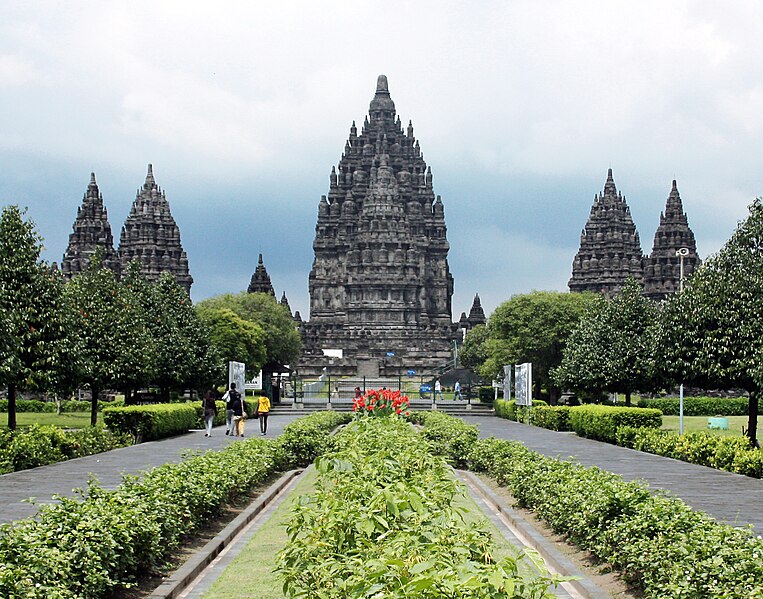
Prambanan Temple Complex – Indonesia


Prambanan Temple Complex was built in the 9th century. This Hindu temple compound is located in Central Java, Indonesia.


This UNESCO World Heritage Site is the largest Hindu temple in Indonesia, and is one of the largest Hindu temples in Southeast Asia.

See also