Tuesday, August 2, 2011

Countries With High-Speed Rails: The 30 Fastest and Most Convenient Trains From Around the World

Currently, China holds the record of most high speed train with 6,158 followed by Spain with 2,665 and Japan with 2,118.

Trains are important form of transportation. They are fast, convenient and no traffics. Here are the fastest trains in the different parts of the world. Usually, only progressive countries have HSR or high speed rails.

1.) Japan


Name: JR-Maglev MLX01
Maximum speed: 581 m/h
Country: Japan
It is the current absolute world speed record holder for railed vehicles.

2.) France


Name: TVG Rame 4402 V150
Country: France
Maximum speed: 574.8 km/h
It is the current world record holder on conventional rails

3.) China


Name: CRH380A
Country: China
Maximum speed:
-Testing: 486 km/h
-Operation: 380 km/h
It holds the world record for the fastest production train.

4.) Germany


Name: Transrapid 09
Country: Germany
Maximum speed: 500 km/h
It is the fastest train in Germany.

5.) China


Name: Shanghai Maglev Train or Shanghai Transrapid
Country: China
Maximum speed: 501 km/h
Top speed: 431 km/h
It is notable for being the first commercial high-speed maglev line in the world


It is the world's fastest train in regular commercial services.
It is faster than the top speed of any production automobile (except for the Bugatti Veyron Super Sport)

6.) China


Name: CHR3 EMU
Country: China
Maximum speed
-CRH3C: 350 km/h
-CRH380B, CRH380BL, CRH380CL: 380 km/h
It is capable of service speed of 380 km/h.


On December 9, 2009, a pair of CRH3 EMUs (CRH3-013C + CRH3-017C) reached a top speed of 394.2 km/h during a test on the Zhengzhou to Xi'an high speed line, setting a world record for double-link EMUs.

7.) Spain


Name: AVE Class 103
Country: Spain
Maximum speed 350 km/h
It is the fastest conventional rail train in commercial use.

8.) Spain


Name: AVE Class 102
Country: Spain
Maximum speed 330 km/h
It is the second fastest train in Spain in commercial use.

9.) Japan


Name: E6 Series/Fastech 360
Country: Japan
Maximum speed: 320 km/h
They are scheduled to enter revenue service in 2011 and will operate at 320 km/h

10.) Germany


Name: ICE 3 Class 407
Country: Germany
Maximum speed: 320 km/h
These trains will enter service as class 407 in late 2011.


It is designed for operation at up to 320 km/h and is wider, quieter and more energy-saving.

11.) Japan


Name: E5 Series Shinkansen
Country: Japan
Maximum speed 320 km/h
It is one of the most sophisticated trains in Japan.

12.) South Korea


Name: KTX-II or KTX-Sancheon
Country: South Korea
Maximum speed: 305 km/h
It is the first commercial high-speed trains developed in South Korea.

13.) Japan


Name: 500 Series Shinkansen
Country: Japan
Maximum speed: 300 km/h
It is one of Japan’s fastest and popular trains.

14.) Japan


Name: N700 Series
Name: Japan
Maximum speed 300 km/h
It can reach a speed of 270 km/h in only three minutes.


Since March 2009, the N700 series trains have been equipped with wireless internet available for use between Tokyo and Shin-Osaka.

15.) Italy


Name: ETR 500
Country:  Italy
Maximum speed 300 km/h
It is the fastest train in Italy.



The last speed record is 362 km/h between Florence and Bologna.
It takes an hour from Milan to Bologna, while a plane with taxis takes an hour and a half.

See also
Enhanced by Zemanta

Notable Ancient Holy Cities From Around the World


Some ancient cities were regarded as holy or sacred cities. Some of these cities still remain as such. Here’s a list of ancient cities of the world considered holy.

Rome, Italy


The ancient city of Rome, which is believed to have been founded by Remus and Romulus, is a holy city for the Ancient Roman polytheistic religion. Numerous temples and statues were built in Rome to honor their gods and goddesses.

Constantinople, Turkey


Constantinople, a city established by Constantine the Great, is regarded a holy city during the Ancient and Medieval times. The city, which is now known as Istanbul, was the Roman Empire’s imperial capital. It was also the imperial capital of the Byzantine Empire, the Latin Empire and the Ottoman Empire. The city was one of the most significant centers of Christianity during the Medieval Period.

Abydos, Ancient Egypt


Abydos was a sacred city in Ancient Egypt. It is located in Upper Egypt and was called Abdju in the ancient Egyptian language which means “the hill of the symbol”. It was the site of many ancient temples which include Umm el-Qa’ab, a royal necropolis for earlier pharaohs. The city is regarded as holy for Ancient Egyptian religion.

Heliopolis, Ancient Egypt


Another city considered holy to Ancient Egyptian religion is Heliopolis – “City of the Sun”. It was one of the most ancient cities of Egypt and was the capital of the 13th Lower Egyptian nome. It is also called the "City of Helios” and the "Eye of the Sun". Many temples have been built in this city during the Ancient times but were destroyed during the Medieval Period. These temples were built to honor and worship their gods and goddesses.

Cuzco, Peru 


The City of Cusco in Peru was a holy city for the Ancient Incas of South America. It was the historic capital of the Inca Empire.  Scores of temples have been built by Ancient Incas to honor their gods and goddesses. Presently, the city is the capital of Cusco Region and Cusco Province. It is the country’s most visited tourist attraction receiving around 1.5 million visitors annually. Designated as the Historical Capital of Peru by the nation’s constitution, it was declared a UNESCO World Heritage Site in 1983.

Nippur, Mesopotamia

Nippur is a sacred city in Mesopotamia, now known as Iraq. In the Akkadian language, the city is known as Nibbur and in the Sumerian language, it is Nibru. Oftentimes, it is recorded as Enlil City. The city was one of the most ancient of all the Sumerian cities and was the special seat of the worship of the Sumerian god Enlil who is regarded as the “Lord Wind”. The city of Nippur is located in modern Nuffar in Afak, Al-Qadisiyyah Governorate in Iraq.

See also

Monday, August 1, 2011

Holy Pilgrimage Sites in the Philippines

Vatican City, Mecca and Jerusalem are just some of the most popular holy pilgrimage sites in the world.

The Philippines is the first ever Christian country in Asia. Hundreds of churches and scores of cathedrals can be found all over the country. Some churches and cathedrals in the country are considered Holy Pilgrimage sites.

Shrine of Our Lady of Manaoag


One of the pilgrimage sites with a large following among Catholic spiritual pilgrims is the Shrine of Our Lady of Manaoag in Pangasinan. Miracles answered by prayers to the Lady of Manaoag are depicted in the murals on the church exterior, contributing to the fervor of many devotees.

Our Lady of Manaoag’s formal name is Nuestra SeƱora del Santissimo Rosario de Manaoag and in English it is Our Lady of the Most Holy Rosary of Manaoag which is a title given to the Blessed Virgin Mary. Our Lady of Manaoag is the patroness of the sick, the helpless and the needy.


The church is one of the Philippines’ most widely visited Catholic Pilgrimage sites. It is located 200 kilometers north of Manila, the countries capital.

Basilica Minore of the Our Lady of Piat


Piat is a municipality in the province of Cagayan in Northern Luzon. One of the world’s shrines to the Virgin Mary is the Basilica Minore of the Our Lady of Piat in Cagayan. It is another well-frequented spiritual pilgrimage venue. The image of Our Lady of Piat, a brown Madonna image, was made in Macau and was believed to be patterned after Mexico’s Guadalupe. Ailments are believed to be healed at this shrine, even by the nuns who sell the miraculous oil that pilgrims can take home after their journey. It is the first basilica minore in its region.

Quiapo Church


Quiapo Church in the City of Manila is one of the most visited churches in the archipelago. Hundred thousands of devotees go to the church during the month of January, Feast of Nazarene. The church is officially known as Minor Basilica of the Black Nazarene.

Santo NiƱo de Cebu
Santo Nino de CebuImage via Wikipedia


The Santo NiƱo de Cebu is a popular Holy Pilgrimage site in the city of Cebu in the province of Cebu in the Visayas. It is called Holy Child of Cebu. The figure of the Child Jesus is highly similar to the Infant Jesus of Prague is clothed in expensive textile robes mostly donations from fervent devotees in the Philippines and abroad.


The statue is the oldest Catholic relic in the Philippines and permanently housed since 1565 at the Basilica Minore del Santo in Cebu City.


Scene at the Basilica Minore del Santo NiƱo during the novena masses

The Santo NiƱo was given by Magellan to the chieftain of Cebu, Rajah Humabon (Carlos), and Hara Amihan (Juana) in 1521.

Antipolo Cathedral
Antipolo Cathedral is a Holy Pilgrimage site in the Philippines in the city of Antipolo. Antipolo city, the capital of Rizal province, is located about 25 kilometers east of Manila.


Shown above is the interior of the National Shrine of Our Lady of Peace and Good Voyage of Antipolo City. It was photographed after the procession rites of the image of Our Lady of Peace and Good Voyage.

Our Lady of PeƱafrancia


The “Our Lady of Penafrancia” in the city of Naga in Bicol region is a well visited Holy Pilgrimage site in the Philippines. Tens of thousands of pilgrims, devotees, tourists go to city every September for nine-day festivities in honor of Our Lady of PeƱafrancia, the Patroness of Bicol.


The PeƱafrancia Basilica Minore is Naga City is where the Our Lady of PeƱafrancia is enshrined.

National Shrine of Our Lady of Fatima


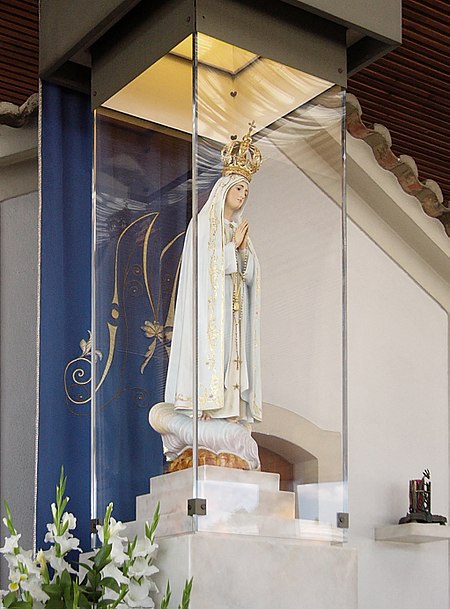
The National Shrine of Our Lady of Fatima is another pilgrimage site in the Philippines. It is a Philippine apostolate of Our Lady of Fatima in Fatima, Portugal in Europe which is recognized by the Philippine Catholic Church. The shrine is located inside the Our Lady Fatima University campus in Marulas, Valenzuela City.

Our Lady of the Pillar


Our Lady of Pillar is a pilgrimage sites for Catholic devotees in Zamboanga City and nearby areas. Our Lady of the Pillar, known in Spanish as: Nuestra SeƱora del Pilar is the name given to the Blessed Virgin Mary. Her shrine is in the Basilica of Our Lady of the Pillar.

Our Lady of Lourdes


A replica of the grotto of Our Lady of Lourdes in San Carlos Seminary, Guadalupe Viejo, Makati City

Our Lady of Lourdes is the name used to refer to the Marian apparition that appeared before various individuals in separate occasions around Lourdes, France.


The apparitions of Our Lady of Lourdes began on 11 February 1858, when Saint Bernadette Soubirous, a 14-year-old peasant girl from Lourdes, admitted, when questioned by her mother, that she had seen a "lady" in the cave of Massabielle, about a mile from the town, while she was gathering firewood with her sister and a friend. Similar appearances of the "lady" took place on seventeen further occasions that year.

Manila Cathedral


One of the most popular cathedrals in the Philippines is the Manila Metropolitan Cathedral-Basilica which is also known as the Cathedral-Basilica of the Immaculate Conception and informally as Manila Cathedral. This is the cathedral church of the Roman Catholic Archdiocese of Manila and is located in Intramuros.

The cathedral is dedicated to the Patroness of the Philippines, Blessed Virgin Mary under the title Our Lady of the Immaculate Conception.

Our Lady of Caysasay


Another pilgrimage and holy site in the Philippines is the Our Lady of Caysasay. Its Spanish name is Nuestra SeƱora de Caysasay. It is a celebrated 17th-century image of the Immaculate Conception dated 1603.


The image was found by a man named Juan Maningcad while casting his net in nearby Pansipit River. The image is about six inches high and the feast day of Our Lady of Caysasay is December 8.

Baclaran Church


Baclaran Curch along Roxas Boulevard is one of the most popular pilgrimage and holy sites in the Philippines. The National Shrine of Our Mother of Perpetual Help which is also called the Redemptorist Church is more popularly known as the Baclaran Church. It is one of the largest churches in the country and houses one of the most venerated Marian images in the country, an icon of Our Mother of Perpetual Help, to which miraculous powers are ascribed. Religious devotees flock to the sanctuary every Wednesday in what has become known as "Baclaran Day", and participate in a novena offered for the Virgin's intercession. The shrine celebrates its annual feast day on June 27.

The building has a seating capacity of 2,000, but as many as 11,000 people can be inside during Masses. An estimated 120,000 devotees are currently affiliated with the shrine.

EDSA Shrine


The Shrine of Mary, Queen of Peace, Our Lady of EDSA, or more popularly, the EDSA Shrine is a small church of the Catholic Archdiocese of Manila located at the intersection of Ortigas Avenue and EDSA in Quezon City. The shrine, built in 1989 originally to commemorate the memories of the People Power Revolution and its peaceful outcome. It is officially called the "Shrine of Mary, Queen of Peace" or "Our Lady of Peace Quasi-Parish", although these names are seldom used.

Malolos Cathedral


Malolos Cathedral, also known as the Basilica Minore dela Nuestra SeƱora de Inmaculada Concepcion or Minor Basilica of Our Lady of Immaculate Conception is the ecclesiastical seat of the Diocese of Malolos in the Philippines. It is another holy pilgrimage site in the Philippines.

Paoay Church


Paoay Church, which is also known as the St. Augustine Church in Paoay, is a historical church located in Paoay, Ilocos Norte. This UNESCO World Heritage Site is one of the Holy Pilgrimage sites in the country. The construction of this very old church began in 1694 and was completed after 200 years in 1894.

Mount Banahaw


Mount Banahaw in Quezon province is considered holy by some religious sects and cults. Just as in old Biblical times, Mount Banahaw is the local version of a holy mountain that lures many a pilgrim to its peak. The holy water said to be flowing on the mountain renders to its appeal, along with the natural features that make the devotees and visitors in tune with God through nature.
.
Related articles you might want to see also